

Bankroll management determines sports betting survival more than any handicapping skill. You can identify value better than anyone, project outcomes accurately, and understand sports deeply — yet still go broke through poor money management. Conversely, disciplined bankroll management sustains betting activity through inevitable losing streaks, compounds winning periods into meaningful profits, and prevents emotional decisions from destroying months of accumulated gains. The mathematics are unforgiving: how much you bet matters as much as what you bet on.
The concept is simple: allocate a specific amount for sports betting, divide it into units, and bet consistent amounts that allow survival through variance. Execution proves harder. Losing streaks tempt increased stakes to recover. Winning streaks create overconfidence that inflates bet sizes beyond prudent levels. The emotional reality of money at risk constantly pressures the rational frameworks that bankroll management requires. Building sustainable betting practice means developing habits strong enough to override impulses that feel compelling in the moment.
Canadian bettors entering the post-Bill C-218 era have unprecedented access to betting options. This abundance demands corresponding discipline. The same variety that creates opportunity also creates temptation — more markets mean more ways to overextend. Treating bankroll management as foundational rather than optional separates those who build long-term betting practice from those who experience sports betting as brief, expensive entertainment.
Establishing Your Bankroll
Your bankroll is money specifically allocated for sports betting, separate from finances needed for living expenses, savings, or other purposes. This separation is both practical and psychological: it defines the limits of acceptable loss and prevents betting from encroaching on financial stability.
The amount should be genuinely expendable. Betting with money you need for rent, bills, or necessities creates pressure that distorts decision-making. Every bet carries enhanced emotional weight because the stakes extend beyond entertainment into survival. This pressure produces exactly the impulsive, desperate betting that bankroll management aims to prevent.
Starting bankrolls typically range from $200 to $2,000 depending on individual circumstances. Smaller bankrolls require proportionally smaller bets, which can feel unsatisfying but preserve the mathematical principles that protect against ruin. A $500 bankroll supports $10-25 standard bets; a $2,000 bankroll supports $40-100 standard bets. The absolute numbers matter less than the relationship between total bankroll and individual bet size.
Consider your bankroll a business investment requiring months to show returns. Professional bettors think in seasons and years, not days and weeks. The recreational bettor who deposits $200 expecting to turn it into $1,000 by next weekend has unrealistic expectations that lead to reckless betting. The bettor who deposits $500 hoping to grow it 20% over a season has achievable goals that support patient, disciplined wagering.
Unit Sizing: The Foundation
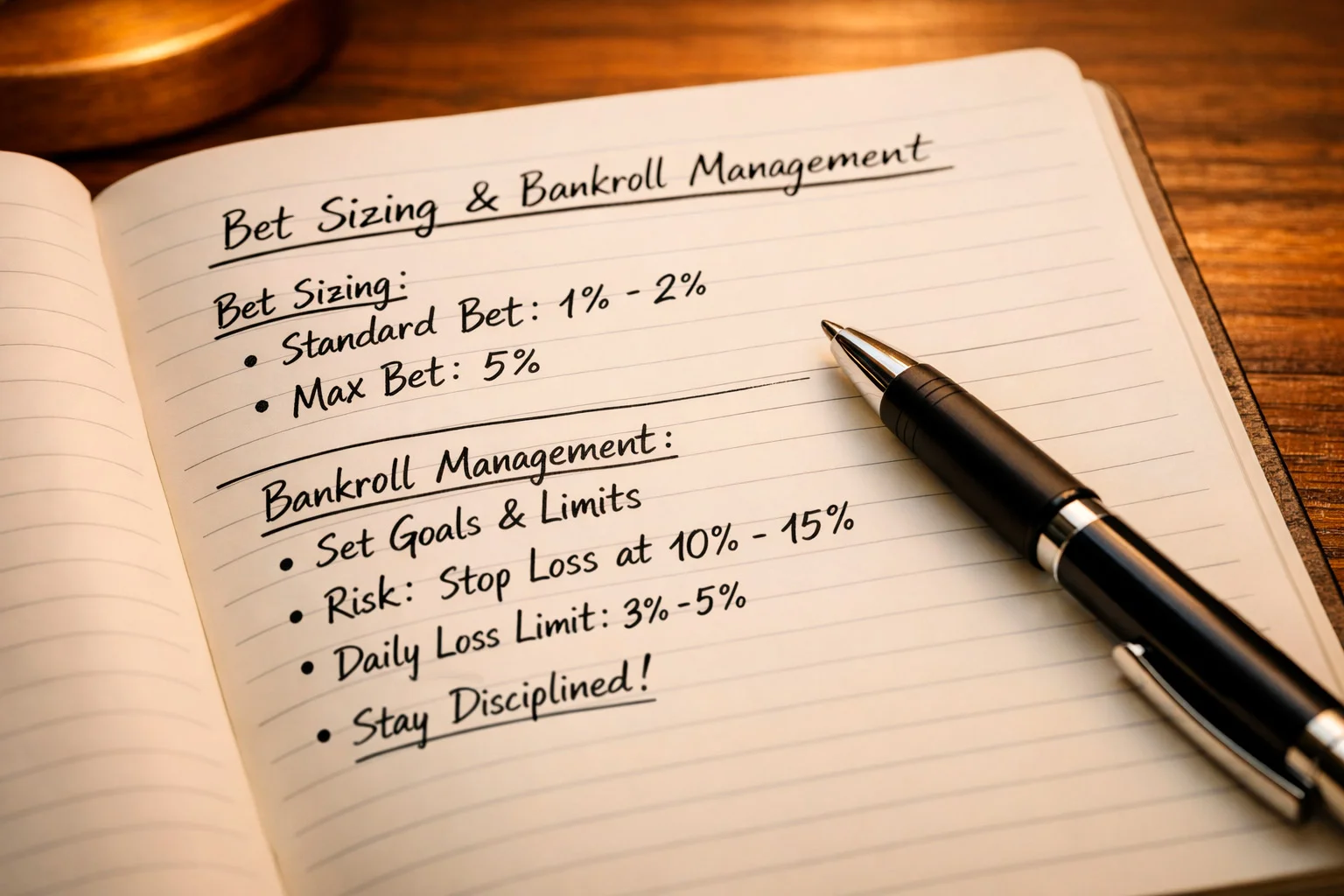
Units standardize bet sizing relative to bankroll. Rather than thinking in dollar amounts that fluctuate with bankroll size, units provide consistent measurement. One unit equals a fixed percentage of your total bankroll, typically 1-5% depending on risk tolerance and betting approach.
Conservative bettors use 1-2% units. With a $1,000 bankroll, one unit equals $10-20. This approach survives extended losing streaks — even ten consecutive losses only depletes 10-20% of total capital. The mathematical cushion provides psychological stability: individual losses don’t trigger panic because they represent small fractions of available funds.
Moderate bettors use 2-3% units. This sizing accelerates both gains and losses. A winning week produces noticeable growth; a losing week creates real contraction. Most recreational bettors with genuine interest in sustainable betting find this range appropriate. The risk-reward balance allows meaningful engagement without excessive volatility.
Aggressive bettors use 4-5% units. This approach suits those with high risk tolerance and genuine edge confidence. The math becomes unforgiving: ten losing bets eliminates 40-50% of bankroll. Recovery from such drawdowns requires extended winning runs that may not materialize. Only bettors with demonstrated, tracked success should consider aggressive sizing.
Professional bettors typically use 1-2% units despite having the most skill. This seeming paradox reflects their understanding of variance. Even 55% win rates produce long losing streaks across large sample sizes. Professionals protect capital precisely because they know they’ll need it across thousands of future bets. The recreational bettor with smaller edge needs even more protection, not less.
Flat Betting Versus Variable Sizing
Flat betting means betting the same amount — one unit — on every wager regardless of confidence level or odds. This approach offers simplicity and discipline. You never have to decide how much to bet beyond your standard unit. The consistency removes a decision point where emotion might override reason.
Variable sizing adjusts bet amount based on perceived edge. A bet you love might get three units; a marginal play gets one. This approach theoretically optimizes returns by concentrating capital on highest-confidence plays. The Kelly Criterion provides mathematical framework for sizing bets according to edge and odds.
The practical problem with variable sizing is accurately assessing edge. Most bettors overestimate their conviction — every bet feels like a good bet when you place it, or you wouldn’t place it. The three-unit bet that loses hurts three times as much as the one-unit bet, and humans are notoriously bad at calibrating confidence. Flat betting protects against miscalibrated confidence by removing the sizing decision entirely.
Beginning bettors should almost always flat bet. Variable sizing requires track record demonstrating that higher-confidence plays actually win at higher rates. Without this evidence, variable sizing merely amplifies random variance. Once you have hundreds of tracked bets showing that your confidence levels correlate with actual outcomes, variable sizing becomes reasonable. Until then, flat betting provides guardrails against self-deception.
Avoid common pitfalls by reading our guide on sports betting mistakes to avoid.
Managing Winning and Losing Streaks
Losing streaks test bankroll discipline most severely. The psychological pressure to recover losses by increasing bet size — chasing — destroys more bankrolls than any handicapping failure. A bettor who doubles stakes after losses needs winning streaks just to return to baseline, and the math compounds against them.
When losing, maintain or reduce bet sizing. Counterintuitive as it feels, decreasing stakes during downswings preserves capital for recovery when variance inevitably turns. A bankroll depleted by 30% through consistent unit betting can recover through continued consistent betting. A bankroll depleted by 70% through chasing requires miraculous runs that rarely materialize.
Winning streaks create opposite temptation: increasing bets because you’re “hot.” This approach ignores that winning streaks reflect variance as much as skill. The bettor hitting 65% across twenty games shouldn’t expect that rate to continue; regression toward true winning percentage is mathematically inevitable. Inflating bet size during hot streaks means larger losses when regression arrives.
The plateau approach offers structured adjustment. Set bankroll milestones — perhaps every 25% growth — at which unit size increases proportionally. A $1,000 bankroll with $20 units might become a $1,250 bankroll with $25 units after reaching that plateau. This system captures growth without emotional stake adjustments. Importantly, maintain unit size during downswings; only increase at defined plateaus on the upside.
Tracking and Honest Assessment
Bankroll management requires knowing your actual results, not your remembered results. Human memory favors wins over losses, creating false impressions of profitability. Only systematic tracking reveals true performance.
Record every bet: date, sport, bet type, stake, odds, and outcome. Calculate win rate, return on investment, and profit/loss by category. This data tells you whether your approach works or merely feels like it works. Many bettors discover through tracking that they’re long-term losers despite vivid memories of winning streaks.
ROI (return on investment) measures betting efficiency better than raw profit. A bettor who profits $500 on $10,000 wagered has 5% ROI; one who profits $500 on $2,000 wagered has 25% ROI. The second bettor is more efficient even though absolute profit matches. Tracking ROI reveals whether your edge justifies the volume you’re betting.
Review results by bet type, sport, and situation. You might discover that your NFL betting produces positive ROI while your NBA betting loses money. This granular analysis enables strategic adjustment: concentrate on profitable categories, reduce or eliminate unprofitable ones. Without tracking, you’re guessing about which parts of your betting actually work.

Psychological Discipline
Bankroll management is ultimately psychological discipline manifesting through mathematical rules. The rules are simple; following them when emotions surge is hard.
Set loss limits per day, week, or session. If you determine that losing five units in a day triggers stop-loss, honor that commitment regardless of perceived opportunities. The opportunities will return tomorrow; the capital you protect today enables future betting that depleted bankrolls prevent.
Avoid betting under emotional influence. Bad news, relationship stress, intoxication, and fatigue all impair judgment. The bet that seems brilliant after several drinks often looks foolish the next morning. Bankroll management includes recognizing when you’re not in condition to bet responsibly and stepping away until you are.
Separate betting decisions from entertainment viewing. Watching games doesn’t require betting on them. The compulsion to have action on everything you watch reflects entertainment seeking rather than value seeking. Disciplined bettors skip games that don’t offer edge regardless of viewing interest.
Accept that losing is inevitable and permanent. Even the best sports bettors lose 40-45% of their bets. Individual losses are simply costs of doing business, not failures requiring immediate correction. This mindset — treating losses as expected variance rather than problems demanding response — underlies sustainable bankroll management.
The Long-Term Perspective
Bankroll management serves long-term survival and growth. The bettor focused on tonight’s games cannot maintain discipline; only the bettor focused on results across seasons sustains the patience that bankroll management requires.
Set realistic expectations for growth. Professional bettors with genuine edge typically achieve 5-10% ROI over large sample sizes. Recreational bettors should aim for smaller gains or entertainment value rather than life-changing profits. The get-rich-quick mentality drives exactly the reckless betting that destroys bankrolls.
Treat sports betting as a marathon requiring years of consistent practice. The bettor who survives their first year of betting with bankroll intact has already outperformed most peers. The one who shows modest growth across multiple years has developed skills that compound indefinitely. Bankroll management is the foundation that makes this longevity possible.
Canadian bettors now have access to the full range of legal and grey-market betting options. This access is opportunity and risk simultaneously. The discipline of bankroll management transforms abundant opportunity into sustainable practice rather than brief, expensive entertainment followed by broke withdrawal. Your bankroll is your betting lifeline — manage it accordingly.
Protect your units with advice from our betting hub.
