

Betting odds serve two fundamental purposes: they indicate probability and determine payouts. Every number you see at a sportsbook — whether displayed as 2.50, +150, or 3/2 — communicates the same underlying information through different mathematical languages. Mastering these formats transforms confusing numbers into actionable intelligence, enabling quick probability assessment and accurate payout calculation regardless of which sportsbook or odds format you encounter.
Canadian bettors face particular complexity because different platforms default to different formats. Provincial lottery products like Pro-Line historically used decimal odds, establishing that format as familiar to longtime Canadian bettors. However, American sportsbooks entering the Ontario market often display their native format, and British-influenced horse racing typically uses fractional odds. The ability to read all three formats — and mentally convert between them — separates fluent bettors from those constantly reaching for calculators.
The good news: once you understand the underlying logic, conversion becomes intuitive. Each format simply represents different ways of expressing the same probability and payout relationship. Learn the patterns, practice the conversions, and you’ll read any odds board as naturally as you read prices at the grocery store.
Decimal Odds: The Canadian Standard
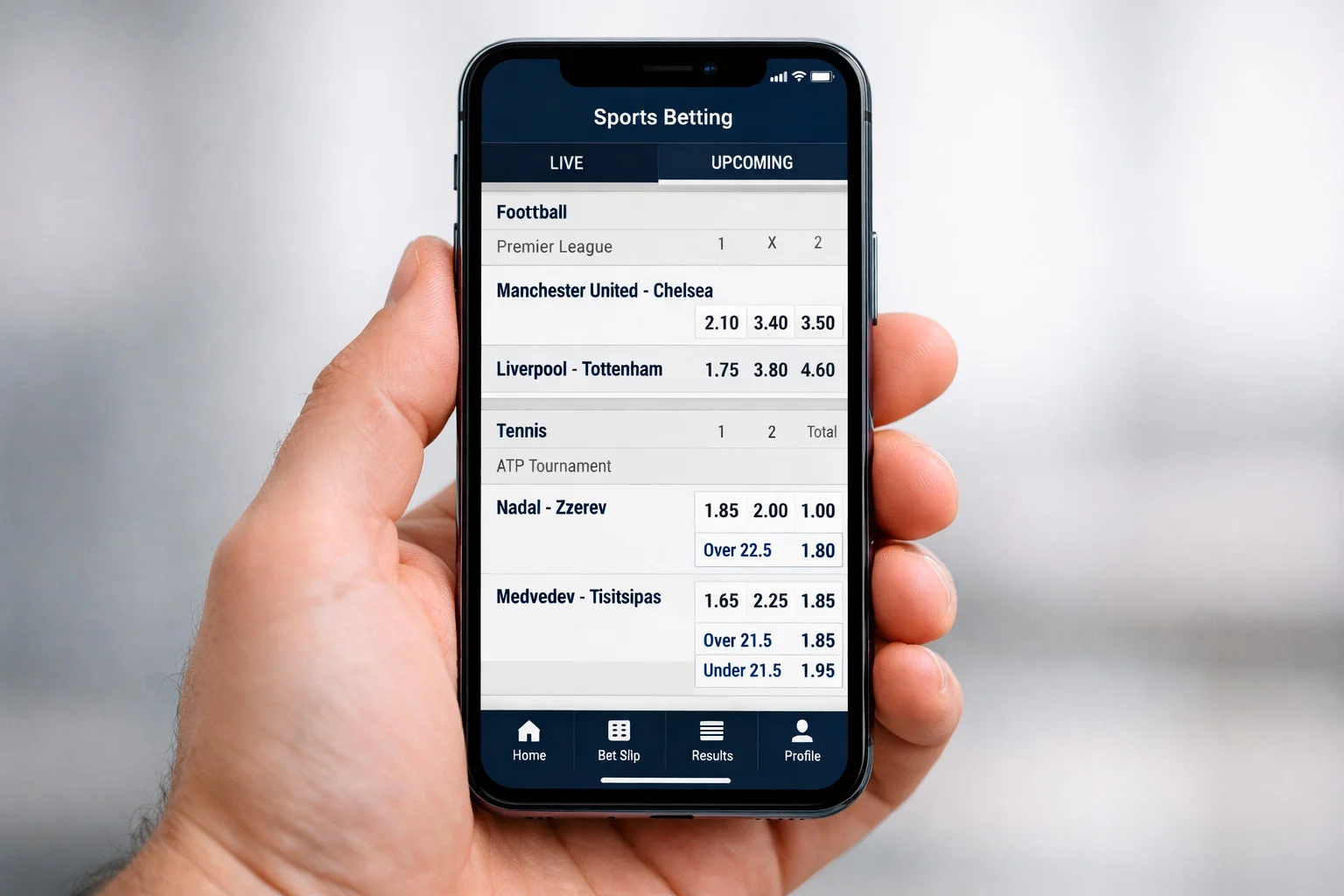
Decimal odds dominate Canadian sportsbooks and represent the most straightforward format for calculating payouts. The number you see — 1.91, 2.50, 3.40 — tells you exactly what your total return will be for every dollar wagered. Multiply your stake by the decimal odds, and you have your total payout including your original bet.
A $100 wager at 2.50 odds returns $250 total: your original $100 stake plus $150 profit. A $50 bet at 1.91 returns $95.50: your $50 stake plus $45.50 profit. The math requires only multiplication, making decimal odds the most calculator-friendly format available.
Decimal odds always exceed 1.00 because they include your stake in the return. Odds of exactly 1.00 would represent a bet where you get only your money back with zero profit — essentially a push. Odds below 1.00 would mean losing money even when winning, which makes no sense in standard betting contexts.
Identifying favorites and underdogs in decimal format is equally simple. Lower numbers indicate favorites; higher numbers indicate underdogs. Odds of 1.50 represent a stronger favorite than 1.80. Odds of 3.00 represent a bigger underdog than 2.20. The relationship is linear and intuitive.
Converting decimal odds to implied probability requires simple division: divide 1 by the decimal odds, then multiply by 100 for percentage. Odds of 2.00 imply 50% probability (1 ÷ 2.00 = 0.50 = 50%). Odds of 4.00 imply 25% probability (1 ÷ 4.00 = 0.25 = 25%). Odds of 1.50 imply 66.7% probability (1 ÷ 1.50 = 0.667 = 66.7%).
Standard spread and total betting in North American sports typically uses -110 juice, which converts to 1.91 decimal odds. Seeing 1.91 on both sides of a spread or total indicates standard pricing. Numbers like 1.87 or 1.95 indicate adjusted juice — important for comparing value across sportsbooks.
American Odds: The Moneyline Format
American odds appear throughout North American sports betting, particularly on broadcasts and at US-based sportsbooks operating in Canada. The format uses positive and negative numbers relative to $100 benchmarks, creating a system that initially confuses many bettors but becomes second nature with practice.
Negative American odds indicate favorites and show how much you must wager to win $100. Odds of -150 mean you must bet $150 to profit $100. If the bet wins, you receive $250 total ($150 stake plus $100 profit). Odds of -200 require betting $200 to win $100; odds of -110 require betting $110 to win $100.
Positive American odds indicate underdogs and show how much profit a $100 wager generates. Odds of +150 mean a $100 bet profits $150 if successful. You’d receive $250 total ($100 stake plus $150 profit). Odds of +200 profit $200 on a $100 bet; odds of +350 profit $350.
The $100 baseline is purely for calculation simplicity — you can bet any amount and the ratio holds. A +150 bet profits 1.5 times your stake regardless of size: a $20 bet profits $30, a $500 bet profits $750. Similarly, a -150 bet requires risking 1.5 times your desired profit: winning $20 requires risking $30, winning $200 requires risking $300.
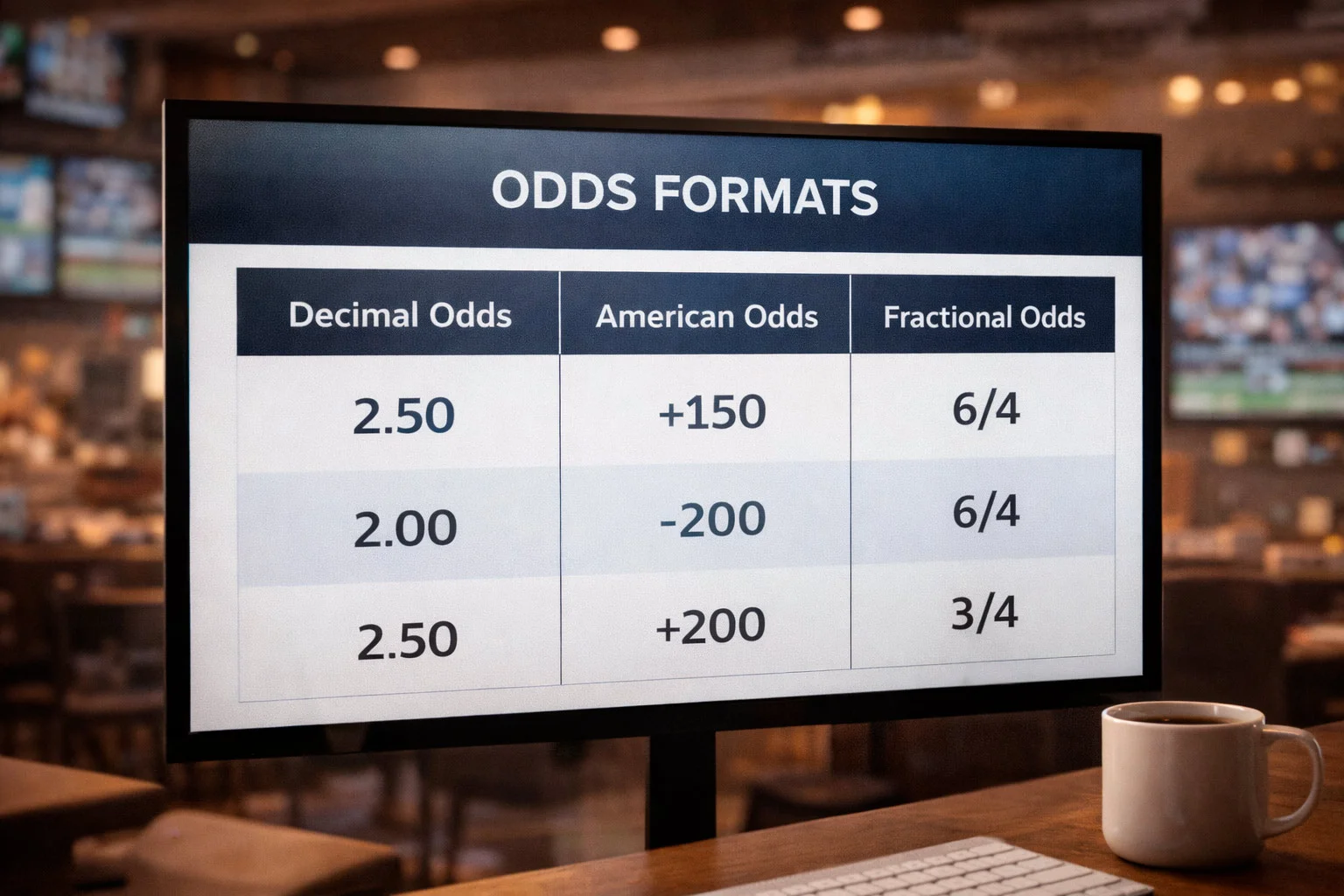
Converting between American and decimal odds follows consistent formulas. For positive American odds, divide by 100 and add 1: +150 becomes 2.50 (150 ÷ 100 + 1 = 2.50). For negative American odds, divide 100 by the absolute value and add 1: -150 becomes 1.67 (100 ÷ 150 + 1 = 1.67).
The standard -110 on both sides of a spread represents the sportsbook’s vigorish — their built-in profit margin. Implied probability of -110 is approximately 52.4%, meaning both sides together sum to about 104.8%. That excess over 100% represents the house edge.
Use this knowledge when analyzing different leagues and sports to bet on.
Fractional Odds: The Traditional Format
Fractional odds appear primarily in horse racing and British-influenced betting contexts. The format expresses potential profit relative to stake using fraction notation: 5/1, 3/2, 7/4, and so forth.
Reading fractional odds is straightforward once you understand the structure. The first number (numerator) represents potential profit; the second number (denominator) represents required stake. Odds of 5/1 mean you profit $5 for every $1 wagered. Odds of 3/2 mean you profit $3 for every $2 wagered — or equivalently, $1.50 for every $1.
Identifying favorites requires comparing the numbers. When the first number exceeds the second (5/1, 3/1, 7/2), you’re looking at an underdog — the potential profit exceeds the required stake. When the second number exceeds the first (1/2, 2/5, 4/9), you’re looking at a favorite — you must risk more than you stand to profit.
Common fractional odds and their meanings: 1/1 (evens) means equal profit and stake — bet $100 to win $100. 2/1 means profit double your stake. 1/2 means profit half your stake. 5/2 means profit 2.5 times your stake. 4/5 means profit 80% of your stake.
Converting fractional to decimal odds involves simple division plus one. Divide the numerator by the denominator, then add 1 for your stake. Odds of 5/1 become 6.00 (5 ÷ 1 + 1 = 6). Odds of 3/2 become 2.50 (3 ÷ 2 + 1 = 2.5). Odds of 1/4 become 1.25 (1 ÷ 4 + 1 = 1.25).
Fractional odds create awkward numbers in some situations, which is why decimal and American formats dominate modern sportsbooks. Trying to express 1.91 decimal odds fractionally produces 91/100 — technically accurate but unwieldy. Most sportsbooks simplify to common fractions that closely approximate the actual odds.
Implied Probability and the Vigorish
Every odds format expresses implied probability — the likelihood the sportsbook assigns to each outcome based on their pricing. Understanding implied probability reveals both expected win rates and the house edge built into every market.
Converting decimal odds to implied probability: divide 1 by the decimal odds. Odds of 2.00 imply 50% probability. Odds of 1.50 imply 66.7% probability. Odds of 4.00 imply 25% probability.
Converting American odds to implied probability requires different formulas for positive and negative numbers. For positive odds: 100 ÷ (odds + 100). Odds of +200 imply 33.3% probability: 100 ÷ (200 + 100) = 0.333. For negative odds: absolute value ÷ (absolute value + 100). Odds of -200 imply 66.7% probability: 200 ÷ (200 + 100) = 0.667.
The vigorish (vig, juice) represents the sportsbook’s margin. In a fair market where two outcomes each have 50% probability, both sides would be priced at 2.00 decimal (+100 American). Instead, sportsbooks price both at approximately 1.91 (-110), making implied probabilities sum to roughly 104.8%. That 4.8% excess is the vigorish — the sportsbook’s guaranteed profit margin regardless of outcome.
Finding value means identifying when your assessed probability exceeds the implied probability embedded in the odds. If you believe a team has 55% chance to cover a spread priced at -110 (52.4% implied), you’ve identified potential value. This gap between your assessment and market pricing is the foundation of profitable betting.
Practical Applications for Canadian Bettors
Different sportsbooks display different default formats, requiring format fluency across platforms. Bet365 defaults to decimal for Canadian users. DraftKings and FanDuel often display American odds. Provincial platforms use decimal. Being able to compare lines across formats prevents missing value due to confusion about what numbers mean.
Line shopping across sportsbooks becomes easier with format mastery. Comparing -115 at one book versus 1.87 at another requires knowing both represent the same format mathematically. The -115 line converts to 1.87 decimal (100 ÷ 115 + 1 = 1.87), confirming identical pricing. But -112 at the first book would be slightly better (1.89 decimal), revealing value in what looked like equivalent lines.
Most sportsbooks allow changing display format in settings. Ontario-licensed operators typically offer all three formats, letting you choose your preference. Selecting one format and sticking with it reduces mental conversion burden for everyday betting while maintaining the ability to read other formats when necessary.
For parlay calculations, decimal odds provide the simplest math. Multiply all leg odds together for combined decimal odds, then multiply by stake for total payout. A three-leg parlay at 1.91, 2.20, and 1.75 produces combined odds of 7.35 (1.91 × 2.20 × 1.75). A $10 wager returns $73.55. American odds require converting to decimal first, making parlays unnecessarily complicated in that format.
Quick mental conversions help in real-time decisions. Know that -110 equals 1.91, +150 equals 2.50, and +200 equals 3.00. These anchor points let you estimate unfamiliar odds by comparison. Something priced between +150 and +200 falls between 2.50 and 3.00 decimal. Something around -130 falls near 1.77 decimal. These approximations suffice for most betting decisions.
The goal isn’t memorizing conversion formulas but developing intuition for what numbers mean. When you see 3.40 decimal odds, you should instantly recognize a significant underdog with roughly 29% implied probability that nearly triples your money if successful. When you see -180, you should recognize a solid favorite requiring nearly double your desired profit as stake. This fluency comes from exposure and practice, transforming foreign numbers into meaningful betting information.
Master the numbers on our Canadian wagering platform.
