

Horse racing holds unique status in Canadian gambling history. Long before single-game sports betting became legal, Canadians could wager on horses at tracks across the country through pari-mutuel pools operating under federal oversight. This traditional form of betting remains vibrant today, with Woodbine Racetrack in Toronto serving as the flagship venue for thoroughbred racing and the King’s Plate standing as North America’s oldest continuously run stakes race.
The betting experience differs fundamentally from sports wagering. Horse racing uses pari-mutuel pools where bettors compete against each other rather than against a house edge, with the track taking a fixed percentage (takeout) before distributing the remainder to winners. This creates dynamic odds that shift based on betting action right up until post time. Understanding these mechanics opens access to a gambling format with deeper history and different strategic considerations than traditional sportsbook betting.
Canadian horse racing combines world-class facilities with accessible betting options. Whether attending races at Woodbine, wagering through HPIbet from home, or placing bets through sportsbooks that offer horse racing markets, the sport provides betting opportunities year-round. The King’s Plate in August serves as the crown jewel — Canada’s equivalent to the Kentucky Derby — but racing continues from April through December at major venues.
The Canadian Racing Calendar
Understanding when and where horses run helps structure betting engagement throughout the year.
Woodbine Racetrack dominates Canadian thoroughbred racing. Located in northwest Toronto, Woodbine’s all-weather Tapeta surface enables racing from mid-April through early December, significantly longer than traditional dirt tracks that depend on favorable weather. Race days typically fall on Wednesdays and Friday through Sunday, with the simulcast facility offering year-round betting on races from tracks worldwide.
The King’s Plate anchors the calendar as Canada’s most prestigious race. Held annually in August at Woodbine, this $1 million stakes race represents the first leg of the Canadian Triple Crown. The 166th running in 2025 saw Mansetti capture victory, continuing a tradition dating back to 1860. The King’s Plate (known as the Queen’s Plate during Elizabeth II’s reign) attracts the nation’s best three-year-old thoroughbreds bred in Canada.
The Canadian Triple Crown continues with the Prince of Wales Stakes at Fort Erie Race Track and concludes with the Breeders’ Stakes back at Woodbine. Completing this series is exceptionally rare — only 12 horses have ever achieved it. Each leg offers its own betting opportunities, with the Triple Crown chase adding narrative drama to summer racing.
Woodbine Mohawk Park serves standardbred (harness) racing, offering a different but equally compelling betting product. Trotters and pacers race year-round at this Milton, Ontario facility, with major events including the Pepsi North America Cup. Harness racing’s different dynamics — drivers rather than jockeys, standard mile distances — create distinct handicapping considerations.
Pari-Mutuel Betting Explained
Horse racing’s betting structure differs fundamentally from fixed-odds sports betting. Understanding pari-mutuel mechanics is essential for informed wagering.
In pari-mutuel betting, all wagers of a particular type go into a pool. The track takes its percentage (typically 15-25% depending on bet type), then distributes the remainder proportionally among winning tickets. Your payout depends not on odds set by a bookmaker but on how much other bettors wagered on your selection relative to the pool.
This means odds displayed are estimates based on current betting patterns, not guaranteed payouts. “Morning line” odds represent the track handicapper’s opening assessment. As money flows into pools throughout the betting period, odds shift constantly until post time locks final payouts. A horse showing 5/1 odds might pay 3/1 or 8/1 depending on late betting action.
The takeout — the track’s cut before payout calculation — varies by bet type. Win, place, and show bets typically carry lower takeout (15-17%) than exotic wagers. Multi-race bets like Pick 4s and Pick 6s often have takeout exceeding 20%. This difference affects expected value calculations: exotic bets must overcome larger house edges despite their appealing potential payouts.
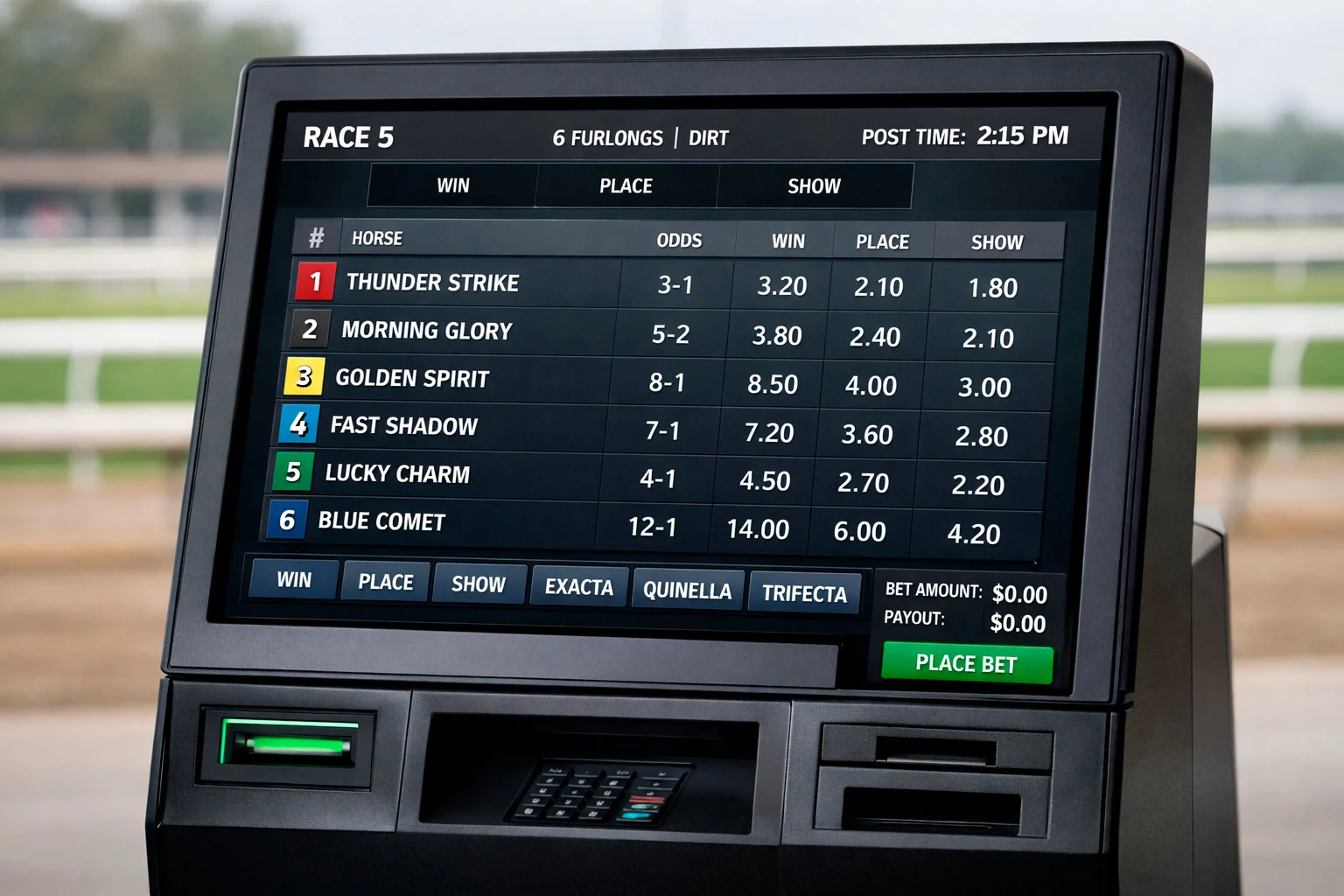
Odds are displayed in fractional format traditional to horse racing. Odds of 5/1 (five-to-one) mean a winning $2 bet returns $12 total: $10 profit plus the $2 stake. Odds of 3/2 mean a winning $2 bet returns $5 total. Unlike decimal odds where the number represents total return, fractional odds represent profit ratio to stake.
Basic Bet Types
Horse racing offers numerous wager types ranging from simple win bets to complex multi-race sequences.
Win bets require your horse to finish first. This is the most straightforward wager: pick the winner, collect if correct. Odds reflect the horse’s perceived probability of winning based on pool betting patterns.
Place bets require your horse to finish first or second. The payout is lower than a win bet because you have two chances to cash. Place pools are calculated separately from win pools, meaning a horse’s place odds don’t directly correlate with its win odds.
Show bets require your horse to finish first, second, or third. Three chances to cash means even lower payouts. Show betting appeals to bettors wanting action with reduced risk, though the low payouts make show wagering mathematically challenging for serious players.
Across the board combines win, place, and show bets on the same horse in a single wager. A $6 “across the board” bet places $2 to win, $2 to place, and $2 to show. If your horse wins, you collect on all three; if second, on place and show; if third, only show.
Exotic Wagers and Multi-Race Bets
Beyond basic win/place/show betting, exotic wagers offer larger potential payouts with correspondingly lower probability of winning.
Exacta requires picking the first two finishers in exact order. In an eight-horse field, there are 56 possible exacta combinations, making correct selection challenging but rewarding. Boxing an exacta — playing all possible orders of two or more horses — increases cost but improves winning probability.
Trifecta extends this to the first three finishers in exact order. With even more combinations possible, trifecta pools often build to substantial amounts, creating significant payouts when favorites falter. Boxing three horses costs six combinations; boxing four costs 24.
Superfecta requires the first four finishers in exact order. The difficulty makes these bets lottery-like, with massive payouts possible when longshots fill out the top four. Most bettors play superfectas with minimal investments hoping for unlikely windfalls.
Daily Double links two races, requiring winners in both. Traditional daily doubles connect specific races (often the first two or last two of a card), while “rolling” doubles let you connect any consecutive races. Successfully identifying two winners produces payouts exceeding what individual win bets would return.
Pick 3, Pick 4, Pick 5, and Pick 6 sequences extend multi-race betting across longer series. These bets challenge bettors to maintain success across numerous races, with difficulty and potential payouts increasing with sequence length. The King’s Plate card in 2025 featured $1 million in guaranteed Pick 5 pools, demonstrating the betting interest these sequences attract.
Check out the full list of available leagues to wager on.
Handicapping Fundamentals
Successful horse racing betting requires evaluating factors that influence race outcomes. While luck always plays a role, informed handicapping improves expected value.
Past performances provide the primary data for handicapping. The Daily Racing Form and other publications offer detailed histories showing each horse’s previous races, including finishing positions, times, track conditions, distances, and competition quality. Reading past performances efficiently requires practice but reveals patterns invisible to casual observers.
Speed figures attempt to standardize performance across different tracks and conditions. Services like Beyer Speed Figures assign numerical ratings to each race performance, enabling comparison between horses that have never competed directly. Higher figures indicate faster adjusted times; consistent figures suggest reliable performers.
Class levels reflect the quality of competition horses have faced. A horse dropping from graded stakes competition to allowance races is facing easier competition; one climbing from claiming races to stakes level faces stiffer tests. Class changes often predict improvement or decline relative to recent form.
Track and distance preferences matter significantly. Some horses excel on dirt but struggle on synthetic surfaces like Woodbine’s Tapeta. Others prefer sprint distances while fading in route races. Matching horse preferences to race conditions identifies situations where form lines might mislead.
Trainer and jockey statistics reveal patterns beyond individual horse ability. Certain trainers excel with specific horse types or race conditions. Leading jockeys win disproportionate percentages of their mounts. Understanding these human factors complements horse-focused analysis.

Betting Platforms for Canadian Players
Multiple options exist for wagering on horse racing from anywhere in Canada.
HPIbet serves as Canada’s primary advance-deposit wagering platform for horse racing. Operated under Woodbine Entertainment, HPIbet offers betting on races from tracks worldwide, including all Woodbine cards. The HPIbet app provides mobile wagering convenience, and the platform integrates with live streaming for many races.
Woodbine’s on-track betting remains available for those attending races in person. The experience of watching horses parade to post, analyzing them visually, and betting through on-track windows provides engagement that remote wagering cannot replicate. King’s Plate day attracts tens of thousands of spectators combining social experience with betting action.
Champions Off-Track Betting locations allow in-person wagering without attending the track itself. These facilities provide simulcast broadcasts of races from multiple tracks, enabling betting and viewing in locations across Ontario. The social atmosphere attracts bettors who want more engagement than home wagering offers.
Some sports betting sportsbooks offer fixed-odds horse racing markets alongside their traditional offerings. These operate differently from pari-mutuel pools — odds are set by the book and guaranteed at bet time rather than fluctuating until post. The trade-off is convenience versus potentially better prices available through pari-mutuel pools.
King’s Plate Betting Considerations
The King’s Plate deserves special attention as Canada’s signature race and a major betting event.
The race features Canadian-bred three-year-olds running 1¼ miles on Woodbine’s Tapeta surface. This specific combination — distance, surface, and restricted eligibility — creates a unique handicapping challenge. Horses with proven form on synthetic tracks and the stamina for classic distance deserve particular attention.
Prep races leading to the King’s Plate provide form lines for evaluation. The Plate Trial, Queen’s Plate (now King’s Plate) Trial, Woodbine Oaks (for fillies), and earlier stakes help identify improving horses and expose pretenders. Tracking performances through these preps reveals trajectory heading into the main event.
Fillies have performed exceptionally well in recent runnings. Caitlinhergrtness won the 2024 edition; Moira completed the Oaks-Plate double in 2022. The King’s Plate doesn’t restrict by sex, meaning fillies facing colts sometimes offer value if bettors underestimate them based on gender bias.
Betting volume on King’s Plate day creates larger pools with more stable odds. The guaranteed Pick 5 pools and extensive wagering menu provide numerous betting angles beyond simple win wagers. Serious horseplayers treat King’s Plate day as the year’s biggest Canadian betting opportunity.
Building Sustainable Racing Engagement
Horse racing betting rewards sustained engagement and accumulated knowledge. Building sustainable habits supports long-term enjoyment.
Start with small-field races where fewer variables enable clearer analysis. Eight-horse fields are more analyzable than 14-horse fields where chaos increases. Maiden special weight races (first-time starters competing for horses that haven’t won) combine interesting puzzles with manageable complexity.
Maintain a separate bankroll for horse racing if you also bet sports. The pari-mutuel structure and different skill requirements suggest treating racing as a distinct activity with its own allocation. This prevents racing losses from affecting sports betting capital and vice versa.
Focus on value rather than winners. Betting the favorite every race produces approximately 33% winners but long-term losses due to short prices. Finding overlaid horses — those whose odds exceed their true probability — creates positive expected value even with lower win rates.
Accept that racing involves significant variance. Even excellent handicappers experience long losing stretches because single-race outcomes contain substantial randomness. Multi-race bets amplify this variance further. Emotional equilibrium through both winning and losing periods supports sustainable engagement.
Horse racing offers betting entertainment distinct from sports wagering, with deeper tradition and different strategic considerations. From Woodbine’s Wednesday cards to the King’s Plate spectacle, Canadian racing provides year-round opportunities for bettors willing to learn its unique mechanics and develop handicapping skills.
Follow the ponies on our horse racing portal.
